Refrigerator Repair
Sub-Zero Fridge Temperature: What It Should Read
The refrigerated section should sit at 35–38°F (about 2–3°C) and never above 40°F. Sub-Zero presets 38°F; here is how to check it and fix drift.
Compiled by Marta Fennimore Refrigeration technician — ice systems and water supply · 12 years in the trade EPA 608 certified
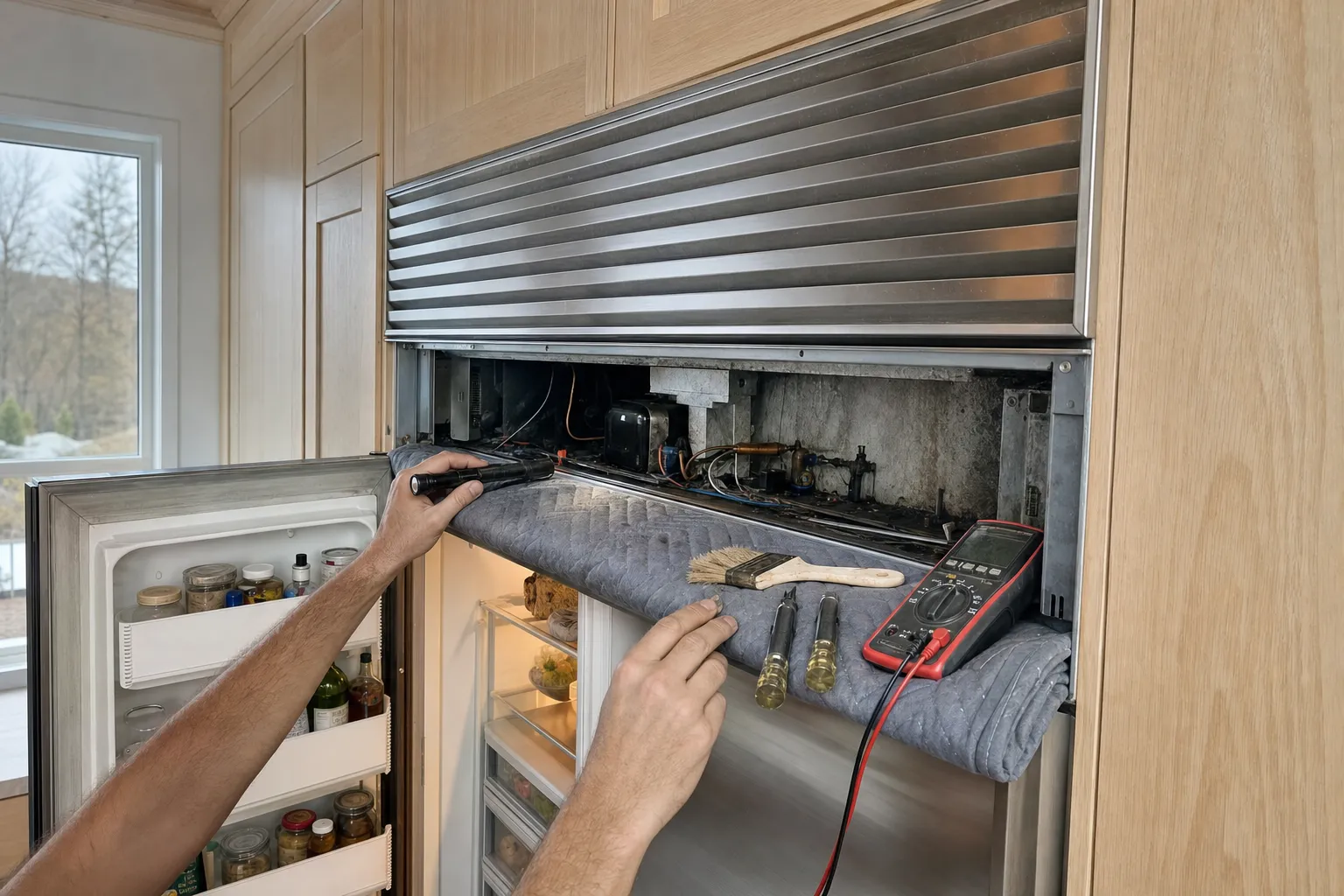
The refrigerated section of a refrigerator should hold between 35 and 38°F, roughly 2 to 3°C, and it should never climb past 40°F (4°C). Sub-Zero ships its Classic and Designer refrigerators set to 38°F for exactly that reason: cold enough to slow bacteria down, yet warm enough that lettuce and milk stay unfrozen. In Sammamish homes, where a built-in usually sits flush inside cabinetry, the number on the control panel and the air on the shelf can disagree by several degrees, so the reading worth trusting is the one a thermometer gives you.
The number to aim for, in °F and °C
Three public sources land in almost the same spot. ENERGY STAR suggests 35 to 38°F. The Department of Energy’s federal efficiency program suggests 36 to 40°F and adds that going colder than 36°F burns extra electricity without keeping food any better. Food-safety agencies draw the hard line at 40°F. Put together, 37 or 38°F is the sweet spot for most households.
| Thermometer reading | Meaning |
|---|---|
| 34–35°F (1–2°C) | Cold; watch for frozen produce at the back |
| 36–38°F (2–3°C) | Right where you want it |
| 39–40°F (4°C) | Acceptable, but nudge it colder |
| 41–45°F (5–7°C) | Too warm; food spoils faster |
| above 45°F (7°C) | Unsafe, by Sub-Zero’s own guidance |
Setting the temperature on a Sub-Zero
Digital Sub-Zero controls move in one-degree steps. Classic (CL) and Designer (DET, DEC) models arrive set to 38°F for the fresh-food side and 0°F for the freezer, and their refrigerator can be adjusted from 34 to 42°F. Classic (BI) and Designer (IT, IC, ID) units allow up to 45°F. The top of either range exists for flexibility, not as a target.
If your CL or DET model has refrigerator drawers, Auto Mode holds them two degrees below the main setpoint but never under 34°F, which suits fish and meat. After any change, leave the unit alone for a full 24 hours before judging the result; pressing Colder again that afternoon only overshoots.
Dial numbers are steps, not degrees
People who search for fridge temperature 1-5 are usually staring at a knob with no units printed on it. Those numbers describe how hard the system works, not degrees. On older Sub-Zero units with a dial, the 500 Series among them, 1 is the warmest position, and Sub-Zero recommends a setting from 4 to 6 for everyday use. Start at 5, wait a day, read a thermometer, then turn the dial one number at a time until the middle shelf settles at 37 or 38°F.
Checking it with a thermometer
Most digital displays show the target you picked, not a live measurement, so test the air with a basic appliance thermometer.
- Pour water into a short tumbler and park it mid-shelf, toward the center rather than in a door bin.
- Drop the thermometer into the water; liquid changes temperature slowly, so the reading mirrors what your groceries feel rather than a blast from the vent.
- Shut the door and leave it overnight, or at least six hours.
- Check it in the morning, opening the door only long enough to read the scale.
- Repeat on the top shelf or in a crisper if one zone seems warmer.
A spread of a degree or two between shelves is normal. Five or more points to an airflow or cooling fault.
Why the reading drifts
Most warm readings have an everyday cause. USDA guidance notes that door bins swing more than the main cabinet, so milk belongs on a shelf, with eggs kept in their carton. A big load of room-temperature groceries can lift the compartment for hours, and a door left ajar, a tired gasket or a crowded shelf blocking the inside air outlet all show up on the thermometer.
A built-in also breathes through the grille at the top. If your kitchen has been remodeled, new panels or a soffit that closes off that grille can starve the condenser, as described in warm since the new cabinetry went in. A unit parked in an unheated garage in Trossachs or Klahanie has its own winter quirks, covered under the garage Sub-Zero that quits in cold weather.
When it will not hold the setting
Rule out the simple things first. If a Classic (BI) display shows Sh r, the unit is in Showroom Mode, which keeps the lights on but does no cooling. To leave it, switch Power off, hold down a Warmer and a Colder key together, press Power, then let go of all three. An error reading 10 r 09 on the same series means the evaporator sensor ran at least 10 degrees warmer than the cabinet sensor; cut the breaker for 30 seconds, and if the code stays gone, nothing more is needed.
Still above 40°F a full day after those checks? Then the cause is usually a fan, a defrost part, a seal or, less often, the sealed system, which is the work on our refrigerator repair page.
What a repair typically costs
Every price depends on what the diagnosis finds, so treat these as typical ranges rather than quotes. An evaporator or condenser fan motor usually comes to $330–$720 and a defrost heater, thermostat or sensor to $300–$690 while a new door gasket runs $300–$630. Compressor or sealed-system work is the heavy end at $1,460–$3,380 for the job.
Our trip to your door costs $89 and includes the whole diagnostic workup; approve the fix and every cent of it is deducted from the repair. The firm price arrives only after the fault is pinned down. Ring (425) 610-8986 for Pine Lake, Sahalee or the streets around them.
During a power cut
When a winter storm takes the power out, the best move is to keep both doors shut. Sub-Zero notes that even an empty refrigerator typically needs about 3 hours to climb past 45°F (7°C) in the fresh-food section, and a full one holds out longer because the food itself stores cold. Once power returns, read the thermometer before eating anything. Perishables that sat above 40°F for more than two hours should be discarded, which also settles the question of a fridge left at 50°F overnight.
Common follow-ups
Is 47 degrees cold enough for a refrigerator?
No. At 47°F, roughly 8°C, the fresh-food side is past both the 40°F food-safety line and the 45°F point Sub-Zero calls unsafe. Lower the setting, give it 24 hours and confirm with a thermometer; if it will not drop, suspect a fan, defrost part or door seal.
Is a fridge safe at 42 degrees?
Not ideally: 42°F is two degrees past the 40°F safety line, so milk, meat and leftovers spoil sooner. Bring it down to 37 or 38°F. On several Sub-Zero models 42°F is the warmest the control allows, a limit rather than a goal.
Is it safe to leave my fridge at 50 degrees overnight?
No, perishable food that spent the night at 50°F, which is 10°C, should be thrown out, because USDA guidance treats more than two hours above 40°F as unsafe. Hard cheeses, whole fruit and most condiments usually come through fine; raw meat, dairy, cooked leftovers and cut produce do not.
What is the ideal refrigerator temperature in Celsius?
Aim for 2 to 3°C, the same band as 35 to 38°F, and keep it under 4°C. Sub-Zero's default of 38°F works out to 3°C, so an untouched setting should already be in range, although only a thermometer on the shelf can prove it.
Why is my Sub-Zero refrigerator not cooling when the display looks normal?
The usual suspects are Showroom Mode left on, a dusty top grille, a door gasket that no longer seals, or a failed fan or defrost part. Look for Sh r on a Classic (BI) display, clear the grille and wait a day; still above 40°F after that means it needs a diagnosis.