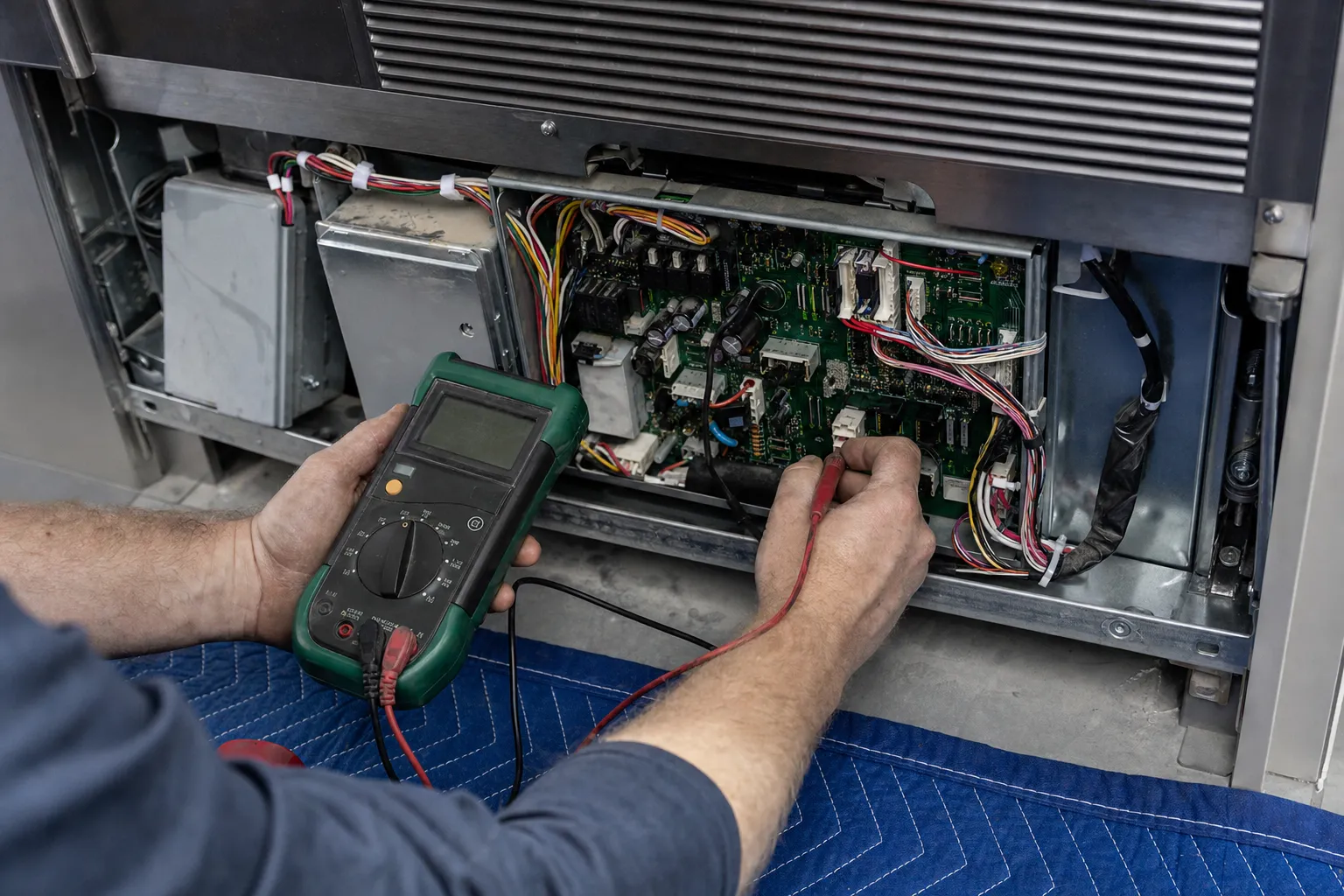
Wine Cooler Repair
Sub-Zero Wine Cooler Zones Drifting Apart: What to Check
When the upper zone of a Sub-Zero wine unit holds and the lower one will not come down, the cause is usually airflow, a tired door seal or a single failed sensor — not the compressor. Here is how to tell which.
Compiled by Marta Fennimore Refrigeration technician — ice systems and water supply · 12 years in the trade EPA 608 certified
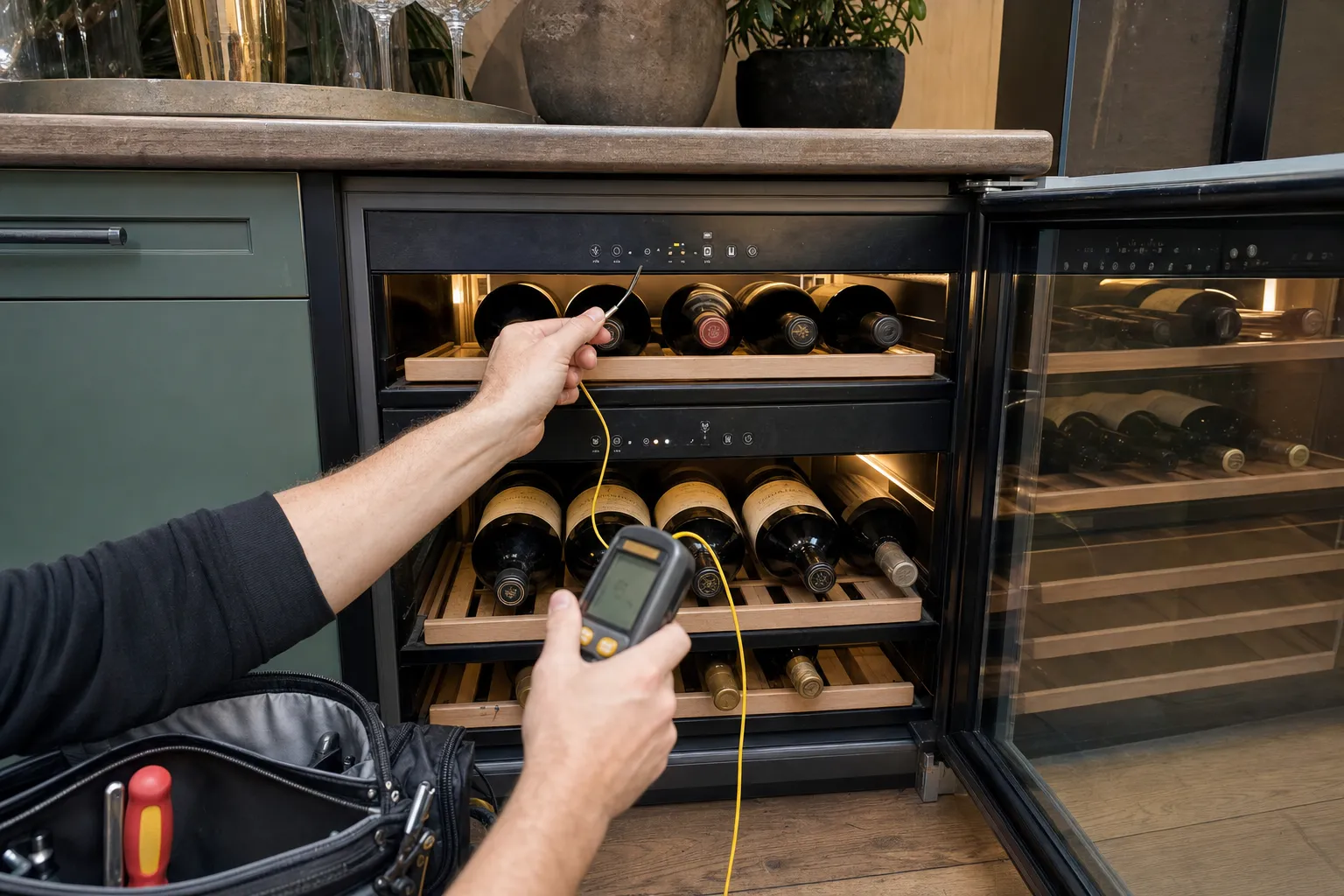
A dual-zone wine unit is the appliance people notice last and worry about most. Nobody opens it three times a day, so a zone can drift for weeks before someone looks at the panel and realises the lower compartment has been sitting at 60°F. By then the assumption is that the compressor has failed and the unit is finished.
It usually has not, and it usually is not. On Sub-Zero wine storage the compressor is generally the most reliable thing in the cabinet. What fails is the machinery that moves and measures cold air, and almost all of it is serviceable in a single visit.
What a healthy two-zone cabinet is doing
Both zones on a Sub-Zero wine unit are fed from one refrigeration system. The cold is produced in one place and then distributed — a fan pushes air through ducting, and a damper or a second fan meters how much of it reaches the second compartment. Every compartment carries a sensor of its own and reports its temperature to the control board, which then opens, closes and cycles to hold two different setpoints out of one source of cold.
That architecture matters because it tells you what a symptom can and cannot mean. If one zone holds perfectly and the other will not come down, the refrigeration system is demonstrably working — cold is being made. What has failed is the distribution or the measurement of it. That single deduction rules out the most expensive category of repair before anyone opens the cabinet.
If both zones drift up together, the picture changes and the sealed system genuinely does come into scope, along with the condenser and its airflow.
The four things that cause a single zone to drift
A blocked or restricted condenser. This is first on the list because it is the most common and the cheapest. Wine units are usually built into a run of cabinetry with a narrow intake grille at the bottom. That grille collects dust, and on the plateau it collects a surprising amount of pet hair. A choked condenser cannot reject heat, capacity drops, and the zone with the longer duct run is the first to suffer.
A tired door seal. Glass doors are heavy and the gasket around them works harder than the one on a refrigerator column. When it hardens or takes a set, warm room air leaks in continuously at the bottom of the door, which is exactly where the lower zone lives. The classic pairing is a lower zone that will not come down plus condensation on the inside of the glass.
A failed circulation fan or damper. If the component that pushes air into the second zone has stopped, that zone effectively becomes a well-insulated box with no cooling. It will sit a long way above setpoint and hold there, stubbornly, rather than swinging.
A drifting thermistor. A sensor reading three degrees low convinces the board a zone is already at temperature, so it stops feeding it cold. The tell here is a panel display that disagrees with a thermometer left on a shelf overnight.
What you can check before booking a visit
None of this needs tools, and any one of them can save you a service call entirely.
- Pull the lower grille and look at the condenser. If you cannot see through the fins, vacuum them carefully with a brush attachment, then give the unit twenty-four hours to recover before judging anything.
- Close the door on a strip of paper at three heights and try to pull it out. If it slides free at the bottom but grips at the top, the seal or the door alignment is your problem.
- Put a thermometer on a shelf in each zone overnight and compare both against the display in the morning. A zone that reads correctly on the panel but wrong on the shelf is a distribution fault; a zone that reads wrong on the panel is a sensor fault.
- Listen at the cabinet with the room quiet. You should hear air moving. Silence from a zone that is not holding temperature points straight at its fan.
- Check the unit is not packed solid. Bottles stacked flush against the rear duct outlets will starve the zone behind them no matter how healthy the hardware is.
When the whole cabinet is warm
If both zones are up, work outward rather than inward. Confirm the condenser is clean and its fan is spinning, confirm there is genuine clearance around the cabinet, and check whether the compressor is running continuously — a unit that never cycles off is a unit that cannot reach setpoint.
Only after that does a sealed-system diagnosis make sense, and it is a proper one: gauges on, suction and discharge pressures read, superheat calculated, evaporator inlet and outlet temperatures compared. Anything short of that is guesswork, and refrigerant guesswork on a wine unit is expensive guesswork.
What we do on a Sammamish call
Wine storage in these kitchens is nearly always integrated, often panel-ready, and frequently in a cabinetry run that was built around it. So the first thing on a wine call is planning the pull, not doing it — panels off in order, protection down, and the unit walked out only as far as the job actually requires.
From there the sequence is fixed: condenser and its airflow, door seal and alignment, circulation fan and damper, then both thermistors against a resistance chart. Four checks, about thirty minutes, and by the end the fault has a name. Seals, fans, dampers and sensors for the common Sub-Zero wine families are stocked parts, so many of these finish in one visit — and the invoice is agreed before the first panel comes off.
Common follow-ups
How far apart should two zones actually be?
A dual-zone Sub-Zero is designed to hold roughly a ten to fifteen degree spread, commonly around 45 to 50°F below and 55 to 58°F above. If the gap collapses to two or three degrees, or stretches past twenty, one zone has lost control rather than both being slightly off.
Is condensation inside the glass door normal in summer?
A light haze on a humid August afternoon clears on its own. Water actually running down the inside of the glass, or a wet lower door frame, means warm room air is getting in continuously — usually a seal, occasionally a door that has dropped on its hinges.
Will the wine be damaged while I wait for a repair?
A few days at 60°F will not ruin anything. Sustained swings are the real risk, because repeated expansion and contraction pushes the cork and lets air past it. If the unit is cycling several degrees up and down every hour, move anything valuable.
Can a wine unit be repaired or do they get replaced?
They are repairable. The parts that fail — fans, thermistors, door seals, dampers and lighting — are all serviceable, and the sealed system on these units is usually the last thing to go. Replacement is rarely the honest answer on a unit under twenty years old.