Freezer Repair
Sub-Zero Freezer Frosting Over Again? Read the Ice First
Frost that returns within weeks of a manual defrost is almost never a door left open. Here is how to read the ice pattern in a Sub-Zero freezer column and work out which part of the defrost circuit has quit.
Compiled by Marta Fennimore Refrigeration technician — ice systems and water supply · 12 years in the trade EPA 608 certified
Frost inside a Sub-Zero freezer column is one of those faults that gets tolerated for far too long. It builds slowly, the unit still freezes, and the obvious fix — pull everything out, run a hairdryer over it, put everything back — appears to work. Six weeks later the white sheet is back on the rear wall and nobody has learned anything.
The ice is worth reading before you touch it. Where it forms, how it is shaped, and how quickly it returns will tell you which of about five parts is at fault, and that is the difference between one visit that arrives knowing what to bring and two that do not.
What frost on the back wall actually means
A Sub-Zero freezer is a frost-free design, which does not mean frost never forms. It means frost is expected to form on the evaporator coil and is supposed to be melted off on a schedule by a small heater wrapped around that coil. Meltwater runs down a drain trough, out through a tube, and evaporates in a pan near the compressor. That cycle runs on a schedule the control sets for itself, adapting to how often the doors are opened.
So a solid frost sheet on the interior back wall means one of two things: either the defrost cycle is not running, or it is running but not producing enough heat to clear the coil. Both feel identical from the kitchen. Both look like a freezer that ices up.
Frost in other places tells a different story. Ice at the door frame or along the drawer gasket is a sealing problem, not a defrost problem. A thin crust on the packages themselves, with a clean back wall, is normal sublimation and means nothing is wrong at all. A lump of clear ice at the bottom of the cabinet, under the lowest drawer, usually means the defrost drain has frozen solid and meltwater is pooling instead of leaving.
The three parts that fail in a Sub-Zero defrost circuit
In practice, three components account for the overwhelming majority of frost calls we run on the plateau.
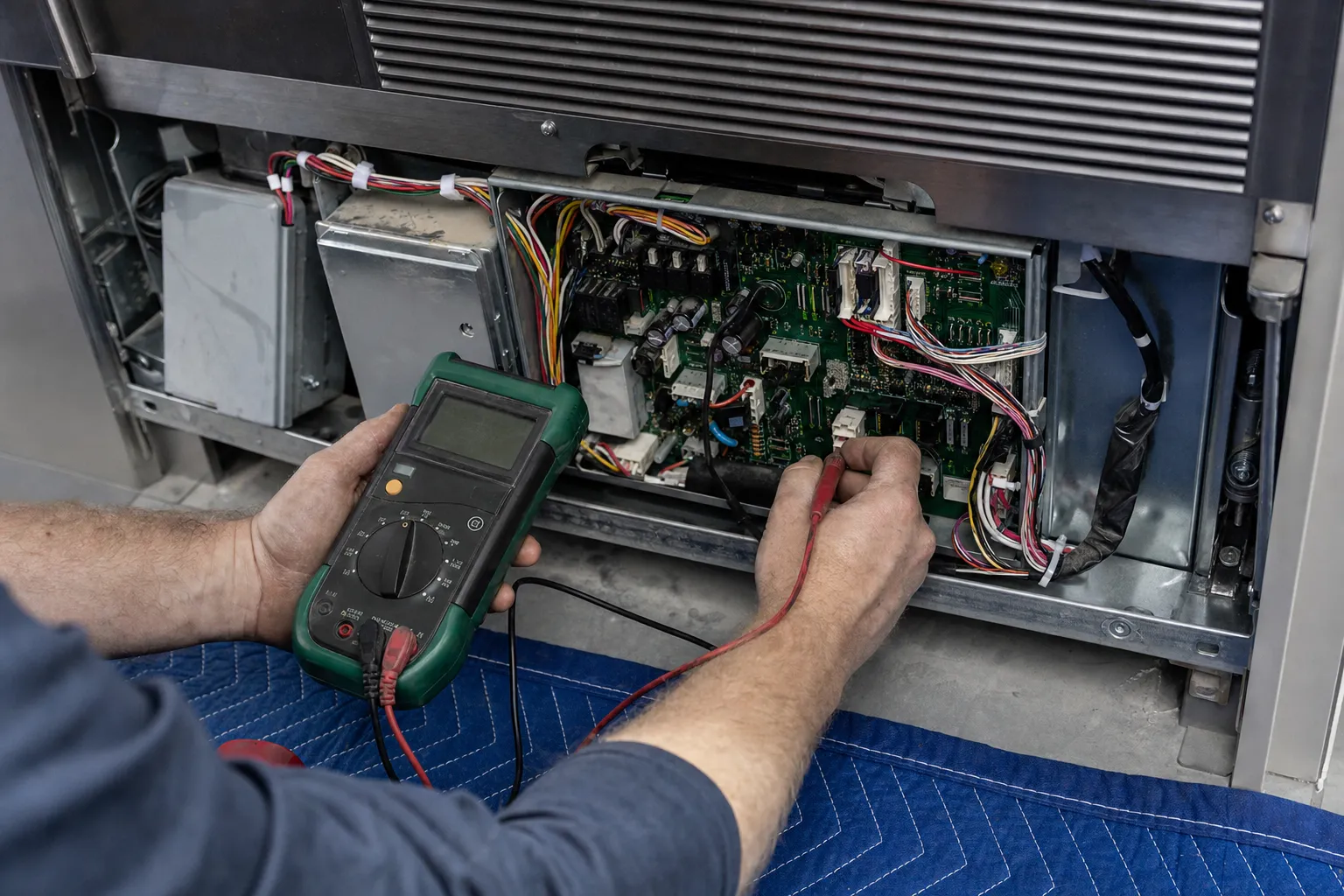
The defrost heater is a resistive element clipped to the evaporator. It either works or it does not, and it fails open — testing across it with a meter gives a clear answer in under a minute. A dead heater produces the classic symptom: a full frost sheet that returns predictably a month after every manual defrost.
The defrost terminator, sometimes called a bimetal or thermal cutout, is a small temperature-sensing switch that has to close before the heater gets power and opens again once the coil warms past a set point. When it fails open, the heater never energises even though the heater itself is perfectly healthy. It is a cheap part and it is often the real answer when someone has already replaced a heater and the frost came back anyway.
The thermistors are the temperature sensors the control board uses to decide when a defrost is due and when the cabinet has hit setpoint. A drifting thermistor can suppress defrost cycles entirely, or convince the board the cabinet is colder than it is. This is the failure that shows up as frost plus a temperature display that does not match a thermometer sitting on the middle shelf.
What you can check before calling anyone
There is a short list worth working through yourself, and none of it requires tools beyond a cheap fridge thermometer.
- Put a thermometer in the middle of the freezer overnight and compare it against the panel reading in the morning. A gap of more than three or four degrees points at a sensor or airflow problem rather than a mechanical one.
- Run your hand around the door or drawer seal with the unit closed. If you can feel cool air escaping anywhere, or the gasket has gone hard and shiny, that alone can load the evaporator faster than defrost can clear it.
- Check that nothing is jammed against the rear grille inside the cabinet. Airflow through a Sub-Zero freezer is directional, and a box of frozen pizza pressed to the back wall will frost that spot and only that spot.
- Look for water — not ice — anywhere under the lowest drawer. Meltwater sitting in the cabinet means the drain is blocked, and that is a separate job from the defrost circuit.
If all four come back clean and the frost still returns on a schedule, the circuit behind the back panel is where the answer is.
When it is not the defrost system at all
Two other faults imitate a defrost failure closely enough to be worth ruling out.
The first is a failing evaporator fan. If the fan stops or slows, cold air stops circulating, the coil ices in an uneven pattern, and the cabinet temperature climbs even though the compressor is running constantly. The tell is noise: a fan on the way out usually clicks, ticks or whirrs before it stops entirely, and it will often run normally for a few minutes after the door is opened.
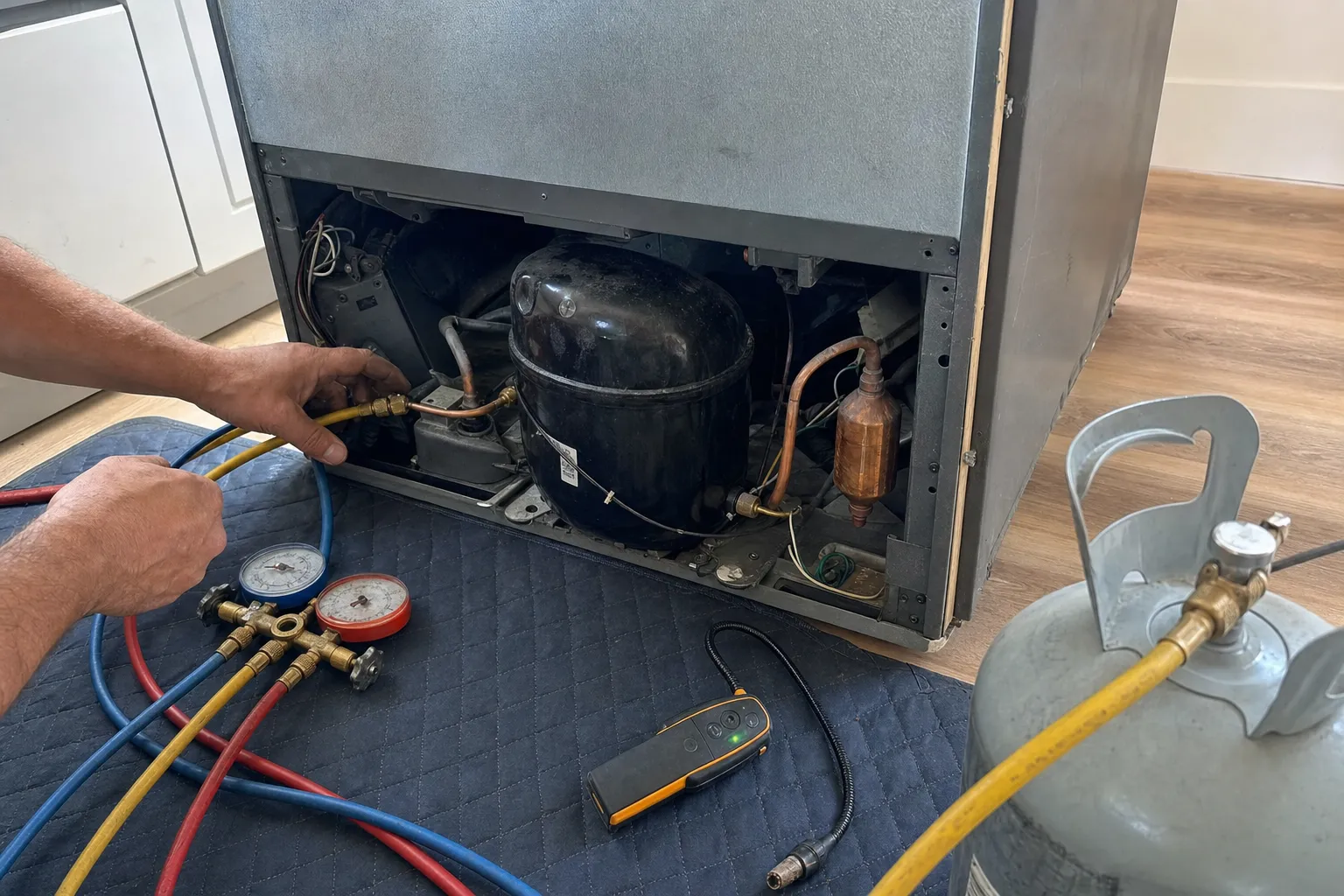
The second is a sealed-system problem — a partial refrigerant loss or a restriction. Here the frost pattern is the giveaway. Instead of an even sheet across the whole coil, you get frost on the first few inches of the evaporator and bare, dry metal beyond it, because there is only enough refrigerant to cool the start of the run. That is a gauges-and-torch job, not a parts swap, and it is worth knowing before anyone quotes you.
What a repair looks like on the plateau
On a typical Sammamish call the back panel comes off, the heater and terminator are tested cold, the thermistors are read against a chart, and the defrost cycle is forced manually so the coil can be watched clearing in real time. That sequence takes about forty minutes and ends with an actual answer rather than a list of possibilities.
Heaters, terminators, thermistors and evaporator fan motors for the common Sub-Zero column families are stocked parts, so many of these are finished in one visit. Sealed-system work is the exception — that gets diagnosed on the first visit, quoted properly, and scheduled with the right materials.
The one thing not worth doing is another manual defrost and hoping. If the ice has come back once on its own, it will come back again, and every cycle in between is costing you compressor hours and cabinet temperature you cannot see.
Common follow-ups
Will manually defrosting the freezer fix it permanently?
Only if the frost came from a one-off event like a door left ajar or a long power cut. If the ice is back within four to six weeks, something in the defrost circuit is not running and a manual defrost simply resets the clock.
Is heavy frost dangerous or just untidy?
It is a real fault. Frost on the evaporator blocks airflow, so the compressor runs longer and longer to hit the setpoint, the fresh-food side starts drifting, and energy use climbs sharply. Left alone, ice will eventually foul the fan blade.
How much of the freezer has to come apart?
On most Sub-Zero freezer columns the back panel comes out with a handful of screws once the drawers and shelving are clear. The evaporator, heater, terminator and fan are all behind that one panel, so testing does not mean dismantling the cabinet.
Can a bad door gasket cause this on its own?
Yes, and it is worth checking before anything else. A gasket that has gone hard or is riding over an ice ridge lets in humid room air continuously. That loads the evaporator faster than a working defrost cycle can clear it.